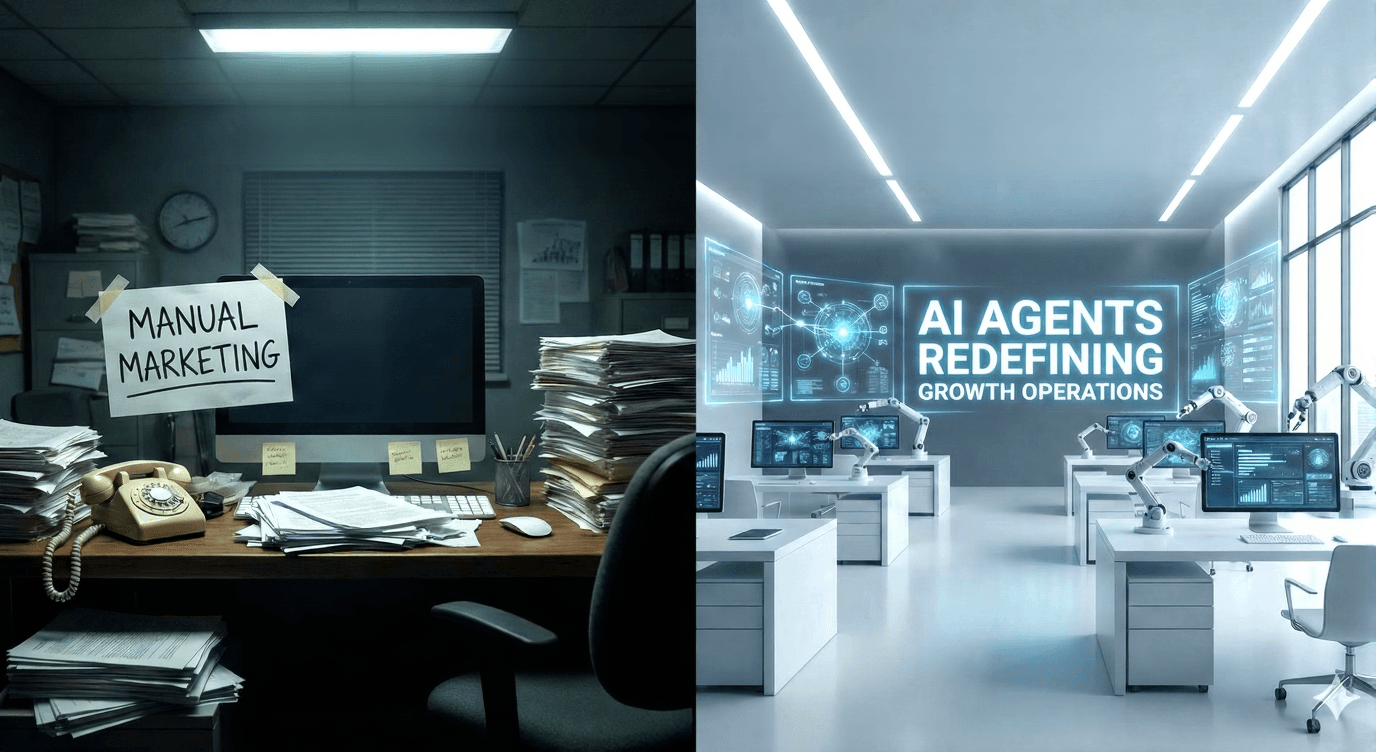
The End of Manual Marketing: How AI Agents Are Redefining Growth Operations
For years, growth teams scaled with hustle—tabs, CSVs, and copy-paste. That era is ending.
A new model is taking over: human strategy + agentic AI execution.
Agentic AI isn’t another writing tool. It’s software that understands intent, plans steps, takes actions, and learns—so campaigns move from idea to impact with far less manual work.
1) Why manual marketing breaks at scale
Tools don’t talk to each other → data is siloed.
People spend hours on non-creative tasks (sourcing, reporting, clean-up).
Each new channel adds coordination cost.
Result: slower cycles, inconsistent output, higher CAC.
2) The practical evolution of AI in marketing
Think of capability in three steps:
| Stage | What it does | Where it helps |
|---|---|---|
| Traditional AI | Rule-based execution, repeatable logic | Data cleaning, ETL, alerts, basic scoring |
| GenAI | Understands and generates content/insights | Briefs, summaries, outreach drafts, analysis |
| Agentic AI | Plans, executes, and adapts multi-step workflows with minimal oversight | End-to-end campaign ops, orchestration, decision support |
GenAI writes. Agentic AI does.
But you can’t skip the first two steps—stable automation and clean data are the foundation.
3) The mistake to avoid: “skip to agents”
Real value rarely comes from a stand-alone “copilot.” It comes from complete solutions:
reliable data pipelines,
thoughtful UX,
clear governance and audit trails,
and a workflow that humans can edit.
Without this base, “autonomy” turns into chaos. Build the groundwork first; then let agents orchestrate.
4) The sequence that works (playbook)
Standardize the workflow
Document steps and success metrics (e.g., “find 30 creators with >3% ER in skincare; launch in 14 days”).Automate the repeatable (Traditional AI)
Scrape, normalize, dedupe, score—make data predictable and trustworthy.Add intelligence where humans bottleneck (GenAI)
Generate briefs, write outreach first drafts, summarize research.Layer agentic orchestration
Let the system plan → act → learn across tools (search, rank, outreach, logging, reporting) with human-in-the-loop checkpoints.Measure velocity, not vanity
Track time-to-ship, experiments per quarter, and impact on CAC—not just likes and impressions.
5) Example: creator sourcing, end-to-end
| Step | Old way (manual) | Agentic way |
|---|---|---|
| Define brief | PM writes doc, sends in Slack | Intent entered once; system structures the brief |
| Find candidates | Search multiple tools, export CSVs | Agent queries platforms, filters by ER/sentiment/safety |
| Shortlist | Hand review in sheets | Scored list with reasons + evidence |
| Outreach | Write emails/DMs from scratch | Personalized drafts + throttled sequences |
| Track results | Manual logging and screenshots | Auto-logging to CRM/Sheet + KPI dashboard |
Time saved: from ~5 hours to ~15 minutes of human review.
Human role: approve tone, pricing, and final list; adjust rules for next run.
6) What to prepare before you adopt agents
Data: clean inputs, unified IDs, consistent attribution windows.
Process: documented SOPs and checklists; known edge cases.
Governance: who approves what, what gets logged, how to roll back.
Culture: ship small wins; review weekly; keep humans in control.
7) The new growth stack: human-guided autonomy
Humans set goals, guardrails, and brand voice.
Agents execute the grind: fetch, filter, draft, follow up, log, report.
Feedback loops convert outcomes into better next runs.
When execution collapses from hours to minutes, your team gets 10× more iteration—and that’s where the compounding ROI lives.
Key takeaways
Manual marketing is too slow for today’s channel sprawl.
Move in order: automation → intelligence → autonomy.
Don’t bolt an “agent” onto a shaky stack; build foundations first.
Measure velocity (time-to-ship, experiments/quarter), not just vanity metrics.
Human-guided agents turn workflows into results—consistently.
CTA (clean, no UTM)
Ready to retire the spreadsheet grind? Start with one workflow, prove the time saved, and scale from there.
Explore how Amplift’s agents help teams plan, execute, and learn—with humans firmly in the loop.